Cantilever Sliding Gate Explain: Space Planning, Power & Access Control
 FACEBOOK
 TWITTER
 LINKEDIN
A cantilever sliding gate offers a trackless, space-efficient way to secure entrances. This guide will help you master the following so you can plan, power, and control gates with confidence:
✓Space planning on slopes and constrained frontages
✓Power architecture for stable, all-weather operation
✓Access control and safety integration for secure automation
Why Space Planning Starts With a Gate
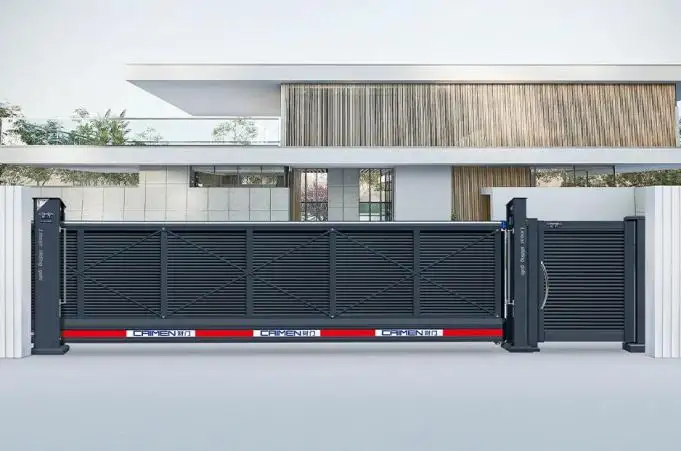
Space is the first constraint for many sites. Parking aisles are narrow, sidewalks are busy, and driveways are sloped or uneven. A gate, especially a cantilever sliding gate, removes the ground track altogether, so the leaf glides above the driveway and moves parallel to the fence line. There is no swing arc, and no trenching for rails that can collect dirt, ice, or debris. This design is well suited to residences, schools, factories, government facilities, and enterprise campuses where appearance, throughput, and uptime matter.
The stability of the moving leaf comes from a balanced structure and a set of engineered components. A correction wheel keeps the gate on a straight path and prevents shake and premature wear. A reinforced tail lever—built with hexagonal aluminum alloy profiles, upper and lower fixings, and 304-grade M20 fasteners—resists sag during travel. Inside the carriage, a guide wheel assembly uses nylon wheels, precision-cast sheet metal, and bearings to reduce friction, dampen noise, and extend service life. A limit sensing system signals the controller when the leaf reaches its endpoints, preventing unnecessary motor run-on and saving energy. Together, these parts translate into a smooth, quiet, and precise glide without the mess and maintenance of ground tracks.
Space Planning for Uneven Ground and Tight Frontage
Because the cantilever sliding gate operates above the driveway, it negotiates uneven grades, snow, and standing water with ease. This matters on sloped entries where a swing gate would foul the ground, or on sites where excavation for a track is impractical. The gate parks along the fence line, preserving vehicle stacking distance and sight lines at the curb. That helps reduce queuing risk and improves first-impression design for residential and commercial frontages.
When planning, consider three zones: the clear opening, the gate storage area along the fence, and the approach zone where vehicles queue. The trackless approach eliminates a cleaning corridor and avoids trip hazards, which is advantageous near pedestrian routes. The refined finish options allow you to align the system with architectural styles while preserving the robust core needed for industrial service. This combination of form and function is ideal where security must coexist with landscaping and parking constraints.
Power Architecture and Reliability in Cantilever Sliding Gate Systems
Power stability is a safety issue as much as an uptime question. The cantilever sliding gate’s power transmission system uses a customized leakage switch, customized cabling, and nylon protection wheels to isolate live components, resist wear, and prevent leakage incidents. The 3-core cable is 99.99% oxygen-free pure copper for low resistance and consistent current delivery. The drive unit is housed in an aluminum-alloy precision die-cast enclosure with high thermal conductivity, so heat dissipates under continuous duty.
Several design choices protect the motor and keep the site operational in harsh weather. The unit starts with high torque for confident movement, tolerates frequent forward and reverse cycling, and includes embedded thermal protection. It continues normal operation at low temperatures down to −35°C. A brushless architecture and intelligent deceleration yield smooth, quiet stopping. Motor self-locking secures the leaf against forced opening, while a manual clutch lets you release the lock to move the gate by hand during an outage.
Features for Day-to-Day Value:
✓ Brushless drive and soft brake: lower noise, less wear, longer service intervals
✓ High/low temperature protection: stable duty in heat waves and freezes
✓ Overload protection: safeguards motor and geartrain when obstructed
✓ Self-locking with manual release: secure when powered, controllable when not
✓ Investment-backed reliability: over one million invested and three years of continuous improvements for endurance under real workloads
Smart Access Control and Safety for the Cantilever Sliding Gate
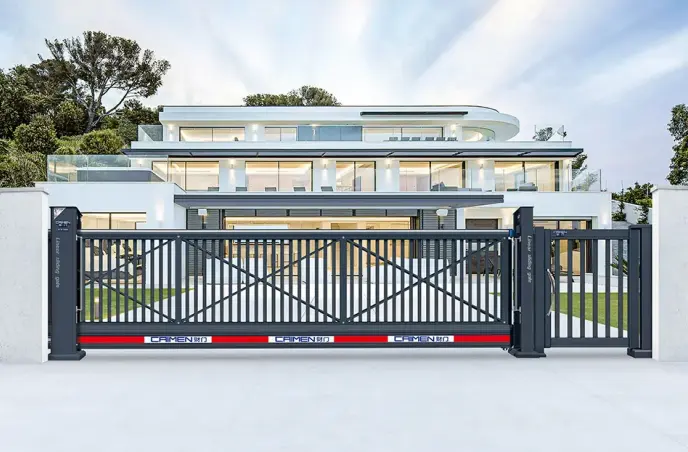
Modern sites expect remote management and rapid response. The 10th-generation digital integrated control system is five times faster than the prior iteration, improving command latency, learning speed, and device compatibility. It integrates with remote controls, security systems, and smart-home or building platforms for centralized monitoring. This means you can unify gate status with cameras, intercoms, and credentialing to support both convenience and audit trails.
Safety layers address real collision and intrusion risks. An infrared anti-climbing function monitors the top beam; ten seconds after the gate closes, if a person or object breaks the beam, an alarm sounds to deter attempts. During closing, the anti-collision infrared sensors watch the passage. If they detect a person or vehicle, the system alarms and automatically stops and returns to avoid contact. An emergency stop switch lets staff cut power instantly. An anti-pinch safety airbag along the leading edge senses pressure; upon activation, the gate reverses approximately one meter and then stops. These mechanisms help reduce liability, protect assets, and maintain throughput even on busy multi-shift sites.
Lifecycle, Maintenance, and Acoustic Comfort
The absence of a ground track cuts a major maintenance burden. There is no rail to clean, de-ice, or re-align. Routine care focuses on periodic inspection of the cantilever assembly, rollers, and fixings. Nylon wheels and precision bearings reduce the friction coefficient, so components run cooler and quieter and last longer. The limit sensing system reduces excess motor runtime, trimming energy use and wear. The aluminum alloy housing aids heat dissipation during peak periods, and the compact, stable drive structure tolerates frequent cycling.
Aesthetics also influence lifecycle cost. A basic yet serene design language suits industrial yards, commercial storefronts, and residential entries. Color and style choices allow owners to match branding or neighborhood guidelines without compromising the steel-core security. Low noise and smooth deceleration contribute to acoustic comfort, a growing concern for mixed-use districts and campuses adjacent to classrooms or offices. In sum, you gain a durable, low-maintenance barrier that respects the site’s visual and acoustic context.
Plan Your Next Step: Site Audit and Integration Roadmap
Transform intent into a build-ready plan. Set up a comprehensive site audit to validate dimensions, electrical, and control systems ahead of procurement. You will receive:
- Space planning for clear opening, storage length, and queue management
- Power and cabling recommendations built on stable, protected components
- Access-control architecture mapping sensors, credentialing, and alarms
- A phased budget and implementation schedule coordinated with operations
Call to action: Request a consultation to assess your site, weigh a cantilever sliding gate versus other solutions, and get a tailored integration roadmap. Strengthen perimeter security, preserve space, and modernize access—without the maintenance burden of ground tracks.